Showing posts with label illness. Show all posts

Tuesday, May 25, 2010

Doin' the Distemper Dance

Distemper is a horror--it is highly contagious, and almost always lethal.  Plus, it's dicey to diagnose since the early symptoms mimic other common ailments, including bordetella (kennel cough), upper respiratory infections and the early stages of parvo.

My little foster Chihuahua, Arabella, who we're calling Princess, probably has it.  It's tentative because obtaining a distemper diagnosis is not easy.  We've got fever (highs up to 104.9 degrees F, currently averaging about 103.4 degrees F), lethargy, despondency, weight loss, loss of appetite, nausea, excessive salivation, dehydration and gummy eyes with red rims.  The kitchen-sink approach (described two posts earlier in this blog) didn't work.  Four days of IVs and antibiotics worked only as long as the catheter was in place. 

So now we're trying something new and controversial--the Dr. Sears treatment, which is based on the "Newcastle" vaccine.  One of our area Vets who has treated animals from the Shelter is offering the three-day series of serum vaccines (taken from healthy donor dogs).   Today, our little Chihuahua received the first of the vaccines, along with an injection of Baytril.

Her sponsor has taken her home tonight because she wants to oversee the dog's treatment.  The sponsor is convinced she can do a better job getting the dog to eat (good luck with that).  Plus, she doesn't have kids.  I'll get the dog back on Thursday, which provides me with a chance to catch my breath.  I have another foster dog, plus my own dog.  Taking care of this dog has been a challenge because my family is still grieving the loss of our dog, and her symptoms have caused her to look a lot like he did (although he didn't have distemper), which pains my 16-year-old to tears.  I don't know if the Newcastle approach will work.  All we can do is try.

According to an ABC news report in March, "Spring is considered to be distemper season. But what's happening now is believed to be more than that. Harris County Animal Control is seeing about 20 percent more distemper cases than normal. Then there's the wildlife population. Raccoons are susceptible to distemper. Since January more have been brought into Houston's Wildlife Rehabilitation Center."  Distemper outbreaks are also reported in Autstin, and are affecting other states as well as Texas--California and Florida are experiencing upticks in cases.  In Toronto, Canada, there is an outbreak of distemper in raccoons that is spreading to dogs.

What galls me is that distemper is one of the most preventable diseases that afflicts dogs.  Years ago, of course, it was a rampant killer, but vaccinations for puppies have put a huge dent in the disease's power.  However, many people don't vaccinate their puppies--and almost all the puppies from unwanted litters arrive at the Shelter vulnerable to the disease.  They are sentenced to death because they are exposed before the vaccines have a chance to take effect.


We can't do much about wild-animal transmission of distemper to dogs, but we can save lives, not mention tons of money, by vaccinating.  As for Arabella, only time will tell.

Thursday, May 20, 2010

Shelter Crash and the Kitchen Sink

This is "Princess" (what my daughter is calling her), aka "Aribella," a Chi Mix foster.  She is I have a foster dog that is suffering from "Shelter Crash" as I call the decline that begins shortly after pulling the dog from the Shelter.  The "Crash" includes an array of symptoms that range from loss of appetite to loose stools, lethargy and fever.  Princess arrived Mother's Day with the "zoomies" and a very active kissy-tongue, but a week later, she lost her pep and zip.

Princess has lost weight she couldn't afford to lose, won't eat much but hand-fed boiled chicken, and won't drink, so we've done sub-cus twice and I'm giving her watered down Royal Canin Recovery by syringe.  She still wags her tail and trots a bit outside, but retreats to her crate or the blankets by the recliner.  Two days ago, she spiked a fairly high fever.  She had a cursory exam by a Vet on Sunday, and has seen another Vet (better--i.e., more attuned to Shelter dog issues) on Monday.  We're heading back this afternoon because she hasn't perked up the way she needs too, although at least she isn't declining horrifically fast.

Meanwhile, we're doing the Kitchen Sink treatment--she's been wormed, and has the bordetella booster, and isn't a puppy, so we're pretty sure it's not parvo.  She's taking an Albon-Metroniadazaole combo in liquid, plus a docycline tablet, plus she's had three days of penicillin injections with B12 added along with some other anti-biotic.  I have given her some Purina foriflora powder and have an anti-diarrhea tablet but haven't given her that since she hasn't had a bowel movement. 

So...what's the deal?  This has happened before with my fosters.  They come home chipper, then crash and burn.  So we try a little of everything because under most circumstances we don't do any diagnostics via blood tests.  This little girl's coughing, discharging snot or wheezing, but it still could be disptemper.  Or giardia, or some other parasite.  Of course, there's one other unknown--she's not been tested for heartworms.  I don't think her symptoms point to heartworms, but then, I'm no Vet.  Plus I think she's coming into heat.

I hope we can get this dog back into shape--she's a little character and will make someone an awesome pet.  

Sunday, April 18, 2010

Lucky Dog

My Miniature Pinscher, Taco, is one lucky, lucky dog—after more than a month of battling a liver ailment, he appears to be fully on the road to recovery. Yesterday, he began eating out of his bowl, and not just sniffing disdainfully at the food. He’s more likely to follow me around in his normal nosey way. He’s had a couple barking spells. And today, the effusion (swelling) in his lower abdomen is clearly diminished.

He still requires meds, including some pills I’ve not been able to get down him. Yesterday he actually took a pill in a pill pocket! Now I have a regimen of meds to improve his liver and guard against ulcer formation. Plus, he’ll stay on antibiotics for another couple weeks.

I’ve not had a foster dog since his illness began and I’ve been too worn out from working with him to do off-site adoptions for the Shelter. My Adoption Team Coordinator has about given up on me. But I just couldn’t focus on the Shelter dogs while my own pet’s illness was so severe.

Here’s what I’ve learned from my experience with Taco:
  1. Be aware that animal treatments are as comprehensive today as human treatments. It should go without saying, but it still threw me for a loop. Taco’s illness would have resulted in certain death perhaps only five or ten years ago. The Vets who cared for the beloved dogs of our childhoods didn’t have sophisticated blood testing, portable sonogram equipment and specially trained personnel to read the results. Plasma transfusions for companion animals were a rarity. All these procedures are readily available, for a price, to most Vets today.
  2. Decide before your dog gets sick what you will do when presented with expensive (and often escalating) treatment options. One of my friends had some lipomas removed from her 7-year-old Cattle Dog’s torso. When her Vet asked if she wanted to have the tissue sent out to analyzed for cancer, she declined. “I didn’t want to know if the tissue was malignant or not. If it came back cancerous, we’d feel too guilty to not treat it,” she explained. “We decided we’d do the removal of the lipomas for the dog’s comfort, but we weren’t going to go further.” To some people, this may sound harsh, but it’s reasonable—my friend is committed to providing palliative care, but not treatment that may or may not work.
  3.  Ask about euthanization costs before the need arises. Some Vets charge an additional cost to euthanize a client’s pet, and others don’t charge faithful clients for the actual injections. There are often other charges that are mandated—disposal fees, etc. Ask so you know ahead of time.
  4. Decide what you want to do with your pet’s remains. If you plan to bury your pet’s remains on your property, you need to make sure local ordinances permit this. Cremation is a popular way to handle a pet’s remains, but procedures and costs vary. The April 2010 print copy of “Houston Pet Talk” has an extremely good article about pet loss, and includes suggestions on how to evaluate the services offered by pet cremation companies
  5. Consider Pet Health Insurance. I don’t have insurance on my pets. My Mom used to carry pet insurance on her pets, but doesn’t now. I asked my Vet for a brochure from the company honored by my doctor’s practice (I use VCA, a corporate Vet, with franchises nationwide—the reasons why are better left for a post in the future). I’m not purchasing insurance, but I did review the brochure. I might consider it in the future. I need more information.
What do you think about pet cremation or pet health insurance? Leave me a comment!

Friday, April 16, 2010

We Are Nearly Out of the Woods


Buddies
Originally uploaded by Calsidyrose
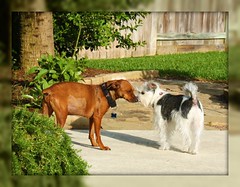
Finally, I think we're on the road to recover with Taco, my Miniture Pinscher (left in the photo) who has been battling a liver issue since March 12th, when he got ahold of a dead squirrel. It's taken $5,000 (yup, you read that right, not that I'm thrilled about it) and round-the-clock effort but he's starting to act like his old self again.

We're still having to force-feed him 2 times daily (a high-protein, low-fat slurry fed through a big syringe) just to keep his protein intake up, but his energy and attitude have vastly improved. This week he has finally begun showing interest in his toys again--he got the "ugee bone" ( a bone-on-a-rope thing) and guarded it vigorously. Yesterday, he "stole" one of Cross's squeaky toys and pushed it at my hands, trying to get me to tug it. He worked at making the squeaker peep for several minutes. He is also starting to lurk under the table again when we eat. We're so relieved.

Would I have spent this much money and effort if I'd known up front what the costs would be? I don't know--we love this dog, but he's always been a challenge-dog. He is mouthy, pushy and doesn't always play well with others. I've owned a muzzle to use when I handle him for medical purposes for years. Our female, Cross, is far more people-oriented and sweet-tempered than this guy.

But we spent the money because he's our dog and we're responsible for him. The potential for prolonged treatment and vet bills is just part of dog ownership, and it is something people need to think about before adding a dog to their lives.

Wednesday, April 7, 2010

There's No Free Lunch--or Free Dog

One of my Dad’s favorite sayings is there’s “no free lunch.” When working with clients who are considering one of our Shelter’s dogs, I echo my Dad’s assessment, adjusting it to, “There are no free dogs.”

Recently, our Shelter altered its fee structure, reducing the cost to adopt a dog or cat from $100 to $75. We also offer lower fees for senior animals, multiple adoptions and long-term Shelter animals. The current fee includes the animal’s spay/neuter, rabies shot, bordetella preventive, yearly vaccination, microchip and a heartworm test (but not treatment, if needed). This is quite a deal—the spay or neuter alone can run around $300 at a local Vet’s office, once meds and other costs are added.

However, many of our clients feel that even $75 is too much for a Shelter dog. True, many of our dogs will need additional Vet attention to combat Shelter-induced infections such as kennel cough, worms, mange, mites, fleas, coccidia and other ailments, but no matter how you look at it, the point-of-purchase (and let’s face it, legally, this is a sale, not an adoption) cost is the least expensive part of owning a dog.

If you get your dog from Craigslist, you can get a “free dog” but most of the ads I see list a “re-homing” fee (which is really a price) ranging from $25 to $800. Of course, the Craigslist flaggers get busy when the “re-homing fee” for a dog is more than $100, but their vigilance has more to do with the stated rules of Craigslist than anything else. In our local paper, some breeds of puppies are marketed at $1,800 or more.

No matter the take-home cost, dogs are not “maintenance-free.”

Regular basic care for a year (including heartworm prevention, regular shots, one Wellness Vet visit with routine shots & fecal/blood tests, decent food and purchases such as bedding, leashes and a few toys) in our area runs about $300 to $600, depending on the size of the dog.

And that’s assuming your dog doesn’t get sick, hit by a car, attacked by another dog or otherwise suffer a serious illness or contract a chronic condition.

For most folks, the costs of a caring for a healthy dog are not problematic. The joy of having a companion animal is well worth it. But when an animal is ill, all bets are off.

So far, I’ve spent about $5,000 treating my dog, Taco, for a severe liver infection due to his dog-natural tendency to nom on dead squirrels. He is about 9 or 10 years old, and was very healthy before this illness. When I opted to start treatment, I was prepared for $2,000 but not double that and more. At each step, I asked my Vet, “Am I throwing money at a dying dog?” And each time, it was clear I was dealing with a critically sick dog, but not one that was at death’s door—unless I simply decided to stop treatment entirely. Of course, the outcome electing not to do IV fluids and one plasma treatment (which were pricey) would have meant death for the dog.

I’ve halted treatments on my own dogs before (both personal pets and foster animals). I have even selected euthanasia when the Vet recommended it. In short, I don’t think I’ve plunged blindly into trying to heroically save a dog’s life when I should have simply “let him die.”

I have sacrificed my summer vacation and a computer upgrade to treat this dog. I haven’t been able to do off-site work or take on a new foster dog. I have learned how to do all sorts of things I never dreamed I’d need to know how to do—how to muzzle and force meds down a dog, how to administer sub-cu fluids, and how to give a dog an enema. I am out of money and worn out. And it’s not over yet. My dog is still not fully recovered. He’s a lot better, and he’s one lucky dog, but he sure as heck ain’t a “free dog.”

When I’m back doing off-sites and my clients start fretting about the cost, I may have to remind them that the cheapest part of dog ownership may well be the point of purchase.

Saturday, March 27, 2010

How to Hold a Nippy Dog

We are learning all sorts of new skills from our experiences with my Min Pin, Taco, who has been battling severe gastro-intestinal illnesses since March 12th.

A very dear friend of mine has been helping me give Taco sub-cu fluids (I’ve learned how to hold the needle in place once she slides it under the skin).  Today we reviewed the process for the “Vet Tech Hug,” which allowed us to administer medicines (pills crushed and dissolved in distilled water and Hills Science Diet A/D food mixed into a thick slurry (20 ccs at a time, administered by mouth through a big syringe).  Taco’s severe pain has made him extremely bitey, and I’ve got bruises and small punctures from his sharp teeth.  Fortunately, he is a small dog, so the bites are small, but his jaws are very powerful.  It hurts like the dickens when he clamps down on a fingerful of Nutri-Cal.

The “Vet Tech Hug” method requires two people, a towel and a slip leash.  The towel is spread on the table to stabilize the dog.  The slip leash is for back up control at the beginning and end of the hug.  The dog is left un-muzzled for this process.  The holder encircles the dog’s neck, using the crook of the elbow like a vise to still the dog’s neck and lift the dog’s snout toward the ceiling.  With the other arm, the holder encircles the dogs body—I’m more comfortable putting my arm over the topline, but it can be easier to slide the arm underneath the dog’s belly.  You pull the dog toward your torso, hugging the animal in a firm squeeze.

I do the holding, and I have to get the grip right on the first go, otherwise, a dog Taco’s size can get leverage with his forelegs and pull his neck out of the grip or snap at my face.  I don’t have a photo, but you can get the idea of the position from the picture above, which I found on Flickr.

While the dog is in my arms, my friend or my husband can take a prepared syringe and squeeze liquefied pills or food into the dog’s mouth.  The key is to place the tip of the syringe in the small gap between the perimolars, as shown in the diagram below.  The dog may mouth the syringe with its canines, but it’s almost impossible for the dog to bite down.  Plus, this puts the syringe tip far enough back in the mouth that the dog is forced to swallow the liquid.

So far, we have given Taco half of his medication dosage for the day and have fed Taco 60 ccs of liquid food (20 ccs at a time, every hour and a half).  The third syringe of food went down with only minimal resistance on Taco’s part.  We’ll feed him again twice before bed tonight and give him his meds.

On Monday, Taco will have another sonogram.  My Vet reviewed the numbers on his liver bloodwork and she suspects sludge in the gallbladder.  A sonogram will confirm that and give us a clear look at the liver and other organs.  Yes, it’s another expense, but if the gall bladder has been affected, it’s actually one of the easier issues to treat.  There’s a possibility that Taco has developed pancreatitis, but we’ll have to wait until Monday.  For now, the key is to get him eating (hopefully on his own) and to get his meds down his throat without getting bitten.

Friday, March 26, 2010

Memories of Old Yeller

We all know what happened to “Old Yeller” in the classic book and Disney film, and we all bawled our eyes out. Of course, back in the days when Old Yeller fought bears and contracted rabies, advanced veterinarian treatments were non-existent.

Today, vet care is as sophisticated as human medical care—even if it is without a bitter Congressional fight—and owners can treat their animals for an ever-expanding range of maladies at an ever-increasing cost.

I’ve spent more than $3,000 on a rescue dog I’ve owned for 10 years. Back when we went to the PetsMart adoption event, we never visualized this, of course. We saw a cute, spirited Miniature Pinscher. We didn’t know he would be a dominant, nippy little twit, but after all these years, we love him, even with his drawbacks.

I was describing Taco’s recent illness to a group of friends, and an older man began describing how his family cared for the dogs of his youth: “We had dogs on our farm in Wisconsin,” he said. “And we never did much for them, but they were healthy and lived a long time. We didn’t even feed them fancy dog food. And we never took them to a Vet. We might have called a Vet for a cow, maybe, but never for a dog.” He was appalled that I had spent so much on “just a dog.”

I didn’t get into it with the gentleman, but 30 or 40 years ago, when he was a boy in Wisconsin, a farm dog might have lived for 3 or 4 years before getting injured, ill or hit by a vehicle. Dogs simply “ran off” never to be seen again. Even when I was a kid in the 1960s, if you had a dog that lived to be 7 or 8, that was an “old dog.” A very old dog.

Most Vets still consider a dog a senior at age 7, but vaccinations, spay/neuter programs, better food nutrition, preventive health checks and a growing list of drugs and treatment options have extended the life-span of our pets. Today, I meet people with 14-year-old Golden Retreivers who still take (slow) daily walks and 18-year-old Dachshunds who might be hobbled with cataracts and toothless, but they still have pep. Advances in Vet care today mean that if you want to spend the money, you can provide your ill pet with blood transfusions, open heart surgery, joint replacement and sophisticated cancer treatments.

Have I spent too much on my nasty little Min Pin? I don’t know. As I told my husband, the time to decide how much you want to spend is BEFORE you are involved in a full-bore treatment plan. I could have stopped, I suppose, after my first visit—skipping the pricey emergency care and nixing the follow-ups. My dog would be dead now simply due to system collapse and dehydration. I’m taking him to the Vet this morning, after watching him slip into a decline last night. However, this morning, his whole attitude seems better.

Still, I warned my daughter that we might have to make that big Decision with this dog. I told I needed to be honest with her—I needed to know if she wants to be with Taco when/if euthanization is needed. She said yes she did. Meanwhile, my conscience won’t let me just abandon this dog to death if reasonable efforts will help him improve. My Vet, at this point, believes he is a good candidate for total recovery. So for now, I will hand over my credit card.

Thursday, March 25, 2010

Taco's Illness Worsens

What an ordeal. The last two weeks have gone by in a blur due to my Miniature Pinscher Taco’s fateful encounter with a dead squirrel.  Since I discovered him with a squirrel carcass, I have been to three different veterinarian offices, and have spent more than $3,000 dealing with his symptoms.

We’ll never know for sure, but my Vet thinks we’re dealing with Salmonella.  Taco went downhill the Saturday after our first Vet visit on March 12th, in spite of three injections (anti-bacterial, anti-nausea and pain medication).  He stopped eating.  His eyes grew squinty, his gums were engorged red but very tacky, and he bit at us while we tried to medicate him. 

On March 14th we took him to the San Antonio Animal Emergency Clinic, which is rated second in the state of Texas behind the facilities at Texas A&M.  Taco spent the night with IV fluids and antibiotics, along with heating pads to raise his abnormal and dangerously low temperature.  There were Xrays and a sonogram.  No sign of tumor, no sign of pancreatic distress, no damage to the liver.  Just sever inflammation all along the gastric track and inflammation around the liver.

March 15th and 16th were spent at Spring Branch Vetinerary Clinic, where my Mom takes her dogs.  We brought him home on March 18th and he saw his regular doctor on March 19th.  His blood work was improved and she gave him 300 ccs of sub-cu fluids, a powerful anti-biotic injection, and a full round of additional meds.  We fed him via syringe, but Taco became more balky and by Sunday, March 21st, Taco had bitten both  me and my husband so hard that we couldn’t give him anymore liquid medicines (muzzling him became an exercise in avoiding Taco’s teeth).

March 22nd, he went back to the Vet for more fluids.  He seemed to improve, making a poop and even eating a bit more enthusiastically on his own.  I found a way to get him to take his pills—a dab of whipped cream cheese worked wonders.  On March 23rd, a friend of mine helped me give him 200 ccs of sub-cu fluids at home to keep his electrolytes in balance.  Afterwards, Taco ate shredded boiled chicken and I/D dog food.  He pooped again the next day.  However, by afternoon on the 24th, he was refusing most food, except for a couple T/D kibbles.

Today, my friend and I gave him another 200 ccs of sub-cu fluids.  His temperature was normal, and his attitude seemed better.  He is still reluctant to eat—I have five open cans of special Hills Science Diet dog foods and he only sniffs at them.  He ate some kibbles, a bit of I/D and a  bit of rice.  However, tonight, his gums are pale and tacky, and he’s hunched over again.  Instead of letting him sleep with my daughter, I’ve tucked him snugly in his “Happy Place,: a bed in the closet.

My daughter, who is almost 16, asked if maybe we had done the wrong thing by treating his illness—she wanted to know if he is in too much pain and needs to be euthanized.  At each stage of this process, I have asked the presiding Vet whether or not we’re trying to treat a dying dog.  Each time, I was told he was critical, but not dying.  We’ve spent more money on this dog to fight this than I’ve ever spent on one animal, but the problem is that once we started treatment, we were pretty much committed. 

Tonight I am concerned we are losing the battle.  I have an appointment for Taco in the morning.  Plus, I had a long conversation with Taco’s doctor this afternoon, and she was hopeful that his improvement would continue.  But his symptoms appear to be worsening.  I am not confident that we can save him.  Only time will tell.

Friday, March 12, 2010

Squirrels + Dogs = Not a Good Idea

“Dug” the talking dog in the Pixar loses all focus when it comes to “Squirrels!”  And so do my dogs, especially my Miniature Pinscher, Taco. Today I went out in the backyard—it’s Spring here in Houston—and saw Taco sunning himself. Then I realized he was guarding something. His prize?—the back half of a dead squirrel.

Yipes! I rushed into the house for a hunk of leftover rotisserie chicken and performed a bait-and-switch. I got Taco inside, picked up the dead squirrel, and realized that we were missing the head and forequarters. Not to mention the guts. The carcass was cleanly cut and fairly fresh, with red flesh and a white spot of bone. No shreds or tears. I think this squirrel got caught in the community association mowers’ blades or perhaps was a dropped by the big black vultures that take care of the roadkill around here in the Piney Woods.

I scoured the yard, letting Taco out twice. Each time, he led me to more squirrel bits—two piles of guts. It wasn’t a fun job. A little later, the barfing and pooping began. Because it’s Friday and because we’re traveling to my folks this weekend, I decided to take Taco to my Vet. I use VCA (it’s a complicated story for another post), which is a chain vet. My dog’s regular Vet had called in sick, so I had a different doctor.

You know the rest of the story—nothing you can’t throw money at. The first estimate was about $450, including a premium blood panel. The examining doctor was concerned about pancreatitis, but I vetoed that call. Taco has eaten all manner of things in the 10 years I’ve had him and has never had anything worse than a regular gastrointestinal upset. I brought him in to see if we needed to purge his gut, and to find out what prophylactic measures to take against Leptospirosis, a bacterial infection carried by squirrels and threatening to dogs. We settled on a less expensive blood-fecal-urine panel, along with a pain injection (my normally stoic dog was hunched and groaning and certainly not his bossy, nippy self) and then added an anti-nausea injection after he hurked up in the car before we could get out of the parking lot. I have the pain meds from a different visit, and so went home with antiobiotic (Metronidazole) and another drug to slow the loose stools. The bill was about $275 by the time we were done.

Taco is groggy from the pain meds and I’ve stashed him in a crate with comfy blankets. Hopefully, his system will settle down and we'll get a clean report on his bloodwork. We’ll take some Science Diet ID along with us before we put him back on regular food. I’ll touch base with his regular Vet, plus I’ve already talked to a Vet Tech friend just to make sure I wasn’t over-reacting. I suppose I could have played “wait-and-see” but I chose not to do that.

Squirrels are fine for chasing, but not good at all for dogs to snack on.

-*-
Top Photo:  "Dug" from the Pixar Movie, "Up"
Bottom:  Taco on the prowl for squirrels.

Tuesday, May 12, 2009

Queeny's Story


This is a long post, but this story is what prompted me to launch a blog. I hope you’ll read through it for Queeny’s sake.

I haven’t written about “Queeny” in this blog because she crept through my life before I launched. But Fred’s post today on “One Bark at a Time” http://onebarkatatime.blogspot.com/ struck me and I want to make sure Queeny is never forgotten.

The Queensland Heelers and Australian Cattle Dogs who arrive at our Shelter rarely fare well. Bred as Thinkers, these dogs seem to sense the horrific end that could be theirs. Many react to the chaos of the Shelter by withdrawing into themselves—slumping in the back of the kennel, their ears at half-cock, their eyes full of reproach.

Queeny (our Shelter lacks imagination when assigning dogs a name, but at least a name is generally bestowed), a little Queensland Heeler mix, was like that. I didn’t see her at first—she was nearly invisible in her grief. When I took her out of the kennel, she slouched toward the door, quietly desperate. Already in the Shelter for three weeks, she came into my view too late. This was right before Valentine’s Day in 2009.

Not that I didn’t try to save her. I took her to an Off-Site event, which, when I am in charge is like a Day Out for the Dogs—with brushings, collars and kerchiefs, a spritz of doggie perfume, good treats, and walks and head pats and time to sit between my knees while I ruffle ears and massage shoulders. But Queen didn’t care. She looked at me with eyes that asked one question: “Who betrayed me?” And I couldn’t give her an answer.

So I tried to tempt her, but nothing worked. She was thin and coughing—I figured it was Kennel Cough, which vexed the Shelter animals all winter. I opened a can of dog food (bought inside the PetsMart where we had set up). She sniffed, licked, and then gave up on it. By the end of the afternoon, she was sliding downhill and I was determined.

Back at the Shelter, it was too late to find a staff member to give her medicine. It would have to wait until Friday morning. So Queeny came home with me, along with another foster (Sweetheart, the hound mix I’ve written about several times). I made them scrambled eggs, mixed it with kibble. She ate the offering and her mood picked up, but only a little.

I kept Queeny and Sweetheart at my house after the Off-Sites through the weekend. I gave her meds for Upper Respiratory Infection and good food. But my husband didn’t want me fostering—he was cranky about the dog hair, the size of the dogs, the crates in the main room, the occasional bark. Plus, he said he didn’t want stinky Shelter dogs in his vehicle, and my old Soccer-Mom van had to go the shop Monday for transmission work.

So I had to take both dogs back on Sunday night. It was 9:00 p.m. at the Shelter. There is nothing worse than the Shelter after hours. When we unlock the dark kennels, and flip on the lights, the dogs wake up and bark in confusion. The barking sounds harsher at night. Shadows pool, even with the lights on. The Shelter is Hell after hours.

Queeny gave me a stoic look—“You, too, have betrayed me.” Exhausted from four-days straight of Off-Sites (it was a special promotion), I wept. I wept all the way home because I knew Queeny was right. I didn’t stand up to my husband. I wasn’t willing to take responsibility for the relationship I’d started with Queeny. I told myself: “The Staff will continue her meds. It’s just a mild URI. She’s eating again. She’ll be fine.”

By the time I had my car back, it was Thursday. I went straight to the Shelter. The Vet Tech told me she was glad I was finally here because “your dog, the Heeler” hasn’t eaten since Monday.” Queeny was in the Surgery kennel because she had faded too much to remain in the chaos of the Adoption Room kennel. She didn’t stand, but lifted her head when she saw me.

I went into the kennel, crouched and cried in her fur. A Staff person brought me a can of dog food and asked me to see if I could get her to eat. She ate for me, then slowly rose, wobbled forward, drank water, then peed by the door of her kennel. I put on her harness and led her out. She wasn’t coming back. I didn’t care what my husband said.

The Shelter Director gave her injections of meds, gave me syringes and tablets, and a tube of Nutra-Cal. I put Queeny in my van and took her home, prepared a soft bed and put the crate in the main room of our house. Queeny stayed with me from February 19th until February 25th.

You know the story—injections (my husband, who was shamed into helping gave the injections while I held Queeny), liquids, tablets, a dozen combinations of taste-tempting tidbits, hand-feeding, finger-feeding, cajoling, slow walks in the grass, stroking and petting, begging and pleading, calling in favors from my best friend who is a Vet Tech, and even a donation from her employer who came out to the Van in front of her office to administer a power punch of injections: “It might work.”

I couldn’t save Queeny. On Ash Wednesday, February 25th, when I crouched by her crate, I could tell she had given up the fight. She was done. I lifted her in my arms and made her a bed on our couch. Weeping, I called a girlfriend, who came over and drove us in my van to the Shelter. I held Queeny on my lap. She wasn’t a big dog, but she had lost so much weight. Her eyes were smoky with Death but she was still breathing.

At the Shelter, there was the normal chaos. We arranged Queeny in the back of my van and my girlfriend stayed with her while I waded through the bureaucratic mud. No, I didn’t want to leave Queeny in a kennel where someone “would take care of it.” Yes, I could wait for the Shelter Director to finish a call. I had to break another promise I had made to Queeny: I had told her she would never go inside the Shelter again. But it is against the rules to perform the final deed in the parking lot.

My girlfriend waited with Queeny until things were ready, then I carried Queeny inside the Shelter to do the final thing. The Shelter Director had a cubbie for an office. We closed the door, and laid Queeny on a clean towel. The pads of her feet were thick: Distemper. We stroked Queeny. I told her how sorry I was.

They left me with Queeny, who I had planned to keep if she had lived, who I had renamed Sasha. She didn’t help or resist when I pulled her into my lap and wept into the brittle fur on her neck. I kissed her between her fox ears. The Vet Tech came for her.

Our Shelter doesn’t use the two-injection method for euthanization. Too expensive is the excuse. The Vet Tech did what she could, including holding Queeny (which is against the policy for some asinine reason) while the injection was made. On Ash Wednesday, February 25th, Queeny’s suffering ended.

I went to church afterwards, at noon. I needed to hear about ashes, dust and bones as brittle as potsherds. I needed to know my part in Queeny’s downfall would be absolved, and that through repentance (which is to turn around) I could do better. Queeny is not the first Shelter dog I’ve lost to death, as there have been others over the years, but she is the one who shouldn’t have died.

I will always remember Queeny, who is now Sasha.